
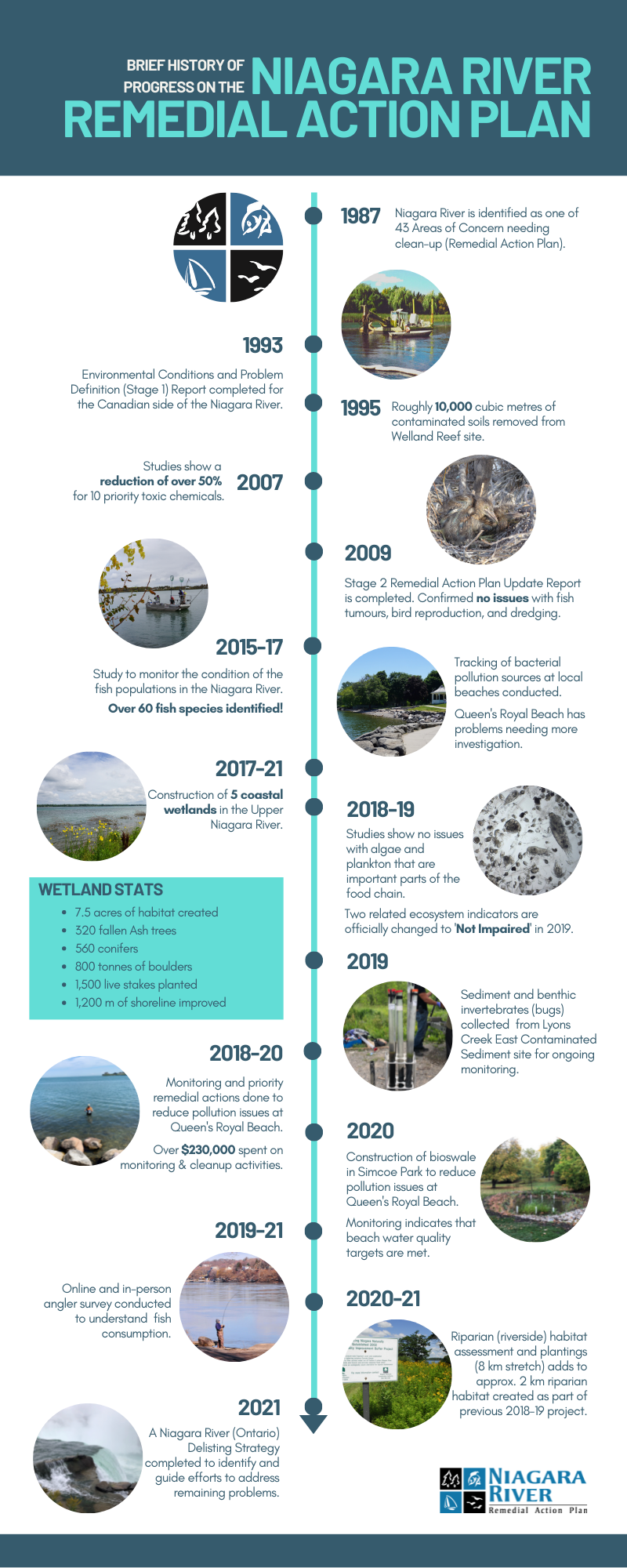
Significant progress has been made in the Niagara River Area of Concern (AOC) since the Remedial Action Plan (RAP) process was first started in 1987. The infographic on the right summarizes the progress and key activities related to the Niagara River RAP since 1987, up to 2021.
Successes achieved over the past 36 years include significant improvements in water quality, and the clean-up of contaminated sediments.
The Niagara River offers several ecological, recreational and economic beneficial water uses such as power generation, tourism, recreation, is a source of drinking water, and supports over 1200 species (see Niagara River Ecology). When something interferes with the enjoyment of a water use, it’s called a beneficial use impairment or BUI. There are 14 potential BUIs identified in the GLWQA (common to all AOCs) that the RAP Team uses to focus restoration needs, track progress and report on success. When taken together, the status of the BUIs tell us the overall condition of the Niagara River AOC.
Remaining Impairments
For the Canadian side of the Niagara River, there are 11 BUIs that are Not impaired and 3 BUIs that remain Impaired. The three Impaired BUIs are:
- Restrictions on Fish Consumption
- Degradation of Benthos
- Loss of Fish & Wildlife Habitat
Recently Re-designated Beneficial Uses
The Niagara River RAP team, in collaboration with experts has recently re-designated 2 BUIs from Impaired to Not impaired for the Canadian side of the Niagara River. They are:
- Degradation of Fish and Wildlife Populations: re-designated in 2025. Learn more, watch the webinar & read the report at the Fish and Wildlife Populations page.
- Beach Closings: re-designated in 2023. Learn more, watch a short video & read the report at the Beach Closings page.
- Degradation of Phytoplankton and Zooplankton Populations: re-designated in 2019. Learn more & read the report at the Phytoplankton and Zooplankton page.
- Eutrophication or Undesirable Algae: re-designated in 2019. Learn more & read the report at the Eutrophication or Undesirable Algae page.
Re-designation of a BUI to Not impaired is a major milestone that reflects coordinated remediation, restoration, and monitoring, and highlights strong collaboration across teams from the Niagara Peninsula Conservation Authority, Indigenous Communities, government agencies, U.S. counterparts, community organizations, and the public.
What’s left to do?
The goal is to complete actions that will restore the beneficial water uses. Once the required actions are complete for an individual BUI, it is assessed against locally-defined goals. If a status assessment shows that the criteria have been met, then the RAP initiates a re-designation process by which the status of the BUI can be changed (i.e., from impaired to not impaired).
In 2021, a Niagara River Delisting Strategy was completed. The Delisting Strategy is a public document (found here) and contains the most up-to-date summary of information about the Niagara River’s remaining BUIs, imparts guidance on BUI removal through the specific delisting criteria, and identifies the recommended remaining priority actions to lead organization(s) involved in the RAP for each of the remaining impaired beneficial uses. An updated Delisting Strategy for the next 5-years is currently underway and will be shared in 2026.
What is the U.S. doing?
To learn more about the efforts to improve U.S. AOCs, including the Niagara River, visit www.epa.gov/great-lakes-aocs.